A Quick-and-Dirty "$$ViewTemplateDefault" (-ish) for XPages

Thu May 03 20:16:00 EDT 2012

Tags: xpages

8.5.3 brought with it the very-handy "Display XPage Instead" property for views. It's great! That way, you can keep more of your existing URLs in old apps or just generally use cleaner ones in new apps - XPages are awesome, but ".xsp" in the URL is not.

In a full-blown app, you're probably going to point each view to its own XPage containing the hand-crafted fancified version. Sometimes, though, you just want to toss a xe:dynamicViewPanel on a page and that's good enough. However, unlike with the equivalent property for Forms, you can't just put a xp:dominoView data source on the page and have it pick up the view the XPage is replacing. With a Form replacement, the server translates a URL like "/view/document" to "/page.xsp?documentId=whatever&action=openDocument" for you; for a View, however, all you get is "/page.xsp". This stymied me when I just wanted to make a generic "View.xsp" to use as scaffolding for new views until I make a real page for each one.

Fortunately, though context.url (context.getUrl() in SSJS) shows the XPage path, you can use a longer property facesContext.externalContext.request.requestURI to get the original request's path info (the part after the server name - the other components are also available in that object). You can use that to fetch what's to the right of the database name (you could use ".nsf/", but facesContext.externalContext.requestContextPath + "/" would probably be technically safer in edge cases, assuming you can use ".nsf" in a folder name on a Domino server) to get the view name (extra line breaks for display purposes):

<xp:dominoView var="dbView">
	<xp:this.viewName><![CDATA[${javascript:
		java.net.URLDecoder.decode(@Right(
			facesContext.externalContext.request.requestURI,
			facesContext.externalContext.requestContextPath
			+ "/"), "UTF-8")
	}]]></xp:this.viewName>
</xp:dominoView>

Not beautiful, but it works. With that and a xe:dynamicViewPanel, you can get a sort of $$ViewTemplateDefault replacement, though you still have to specify it for each view.

The Greatest Domino Poster of All Time

Fri Apr 20 19:23:00 EDT 2012

My company is moving out of the offices it has inhabited for... longer than I've been alive, basically. During this move, we've had plenty of opportunities to come across relics of its past form as an instructor-led training location: old courseware, ancient versions of Windows, NetWare, and Notes/Domino (from before it was Domino), and some priceless marketing materials. Some of the posters we've found are worth a good chuckle or two (a NotesMail poster boasting "Finally, a mail system you will never have to exchange"), but this one is my absolute favorite thing related to Domino:

Amazing Domino poster

It's amazing, like a Domino ad out of Yellow Submarine. What I wouldn't give to have IBM's marketing to be more "Then, suddenly, bursting from a magic lotus blossom" and less "The Social server software for Socially Socializing with Social people in a Social way - just ask this guy in a tie."

Fun fact: the hooded "executioner" guy in the top right being punched out by Domino is labeled "SuiteSpot". SuiteSpot, it appears, was some sort of Groupware/web/mail/directory offering from Netscape. I guess Domino won that battle.

LotusLearns did a poor job copying my post

Fri Apr 20 19:13:00 EDT 2012

Tags: LotusLearns

So apparently, this site LotusLearns has been re-posting quite a few Lotus blogs without permission, and my recent Ruby action plan post made the cut. It's bad enough to see my post aggregated without permission and plastered with ads that don't make me any money, but it's even worse that the replica of the post is thoroughly corrupt.

For one, it leaves of the "S" in the opening "So". Additionally, the XSP markup I posted is passed through to the browser unencoded, leaving a bunch of blank lines. Finally, the precious, precious Ruby code itself is entirely mangled, with the meaningful line breaks stripped (I used "white-space: pre" in the original).

So, in summary:

  1. Don't re-post work without permission.
  2. If you're going to illegally re-post work, at least don't mangle it, particularly when it's a post about programming.

Arbitrary Scripting Languages in XPages

Thu Apr 19 20:12:00 EDT 2012

I think I've settled on JSR 223, the generic "Scripting in Java" specification, as the likely best way to embed Ruby. It seems like the "correct" way to do it and generally the cleanest. I don't like the notion that the way to customize the runtime is by setting system properties, so I'm still a little wary, but it'll do for now, in any event.

The side benefit of JSR 223 (and this would be true of BSF as well) is that it supports a crapload of languages, and it does so in a very unified and generic way. Accordingly, I modified my ViewHandler and created a GenericBindingFactory to browse through the list of non-Ruby available languages and create EL bindings for each.

The upshot is that, when this code is active, any JSR-223-compliant language in your server's classpath will become available for "#{whatever: ... }" bindings just by virtue of its presence. Note, though, that that doesn't necessarily mean it will be a good experience. For one, the page's variables (like param, facesContext, view, and so forth) aren't just available - you'd have to make something like the method_missing method I wrote for Ruby to automatically resolve them via FacesContext.getCurrentInstance(). Furthermore, some languages are problematic: for some reason, Jython throws NullPointerException errors for even the most basic formulas on almost every page load, while PHP still requires <?php ?> tags and spits anything else out to the server console.

I know what question is on the tip of your tongue, though, so I won't keep you waiting: yes, you can use your home-grown string-concatenation operators in Scheme! You can breathe a sigh of relief now:

<xp:text><xp:this.value><![CDATA[#{scheme: (set! + (let ((original+ +)) (lambda args (if (and (not (null? args)) (string? (car args))) (apply string-append args) (apply original+ args))))) (+ "Hello " "from " "Scheme") }]]></xp:this.value></xp:text>

Yes, that works, and no, there's no reason to do it. If you really like Lisp, though, Scheme and Clojure can now be in your XPages toolbox.

Once I'm able to post to OpenNTF, I'll include this in my first Ruby-in-XPages release, though I may leave the applicable code commented out by default. Who knows what horrors this could unleash?

An Action Plan for Ruby-in-XPages

Fri Apr 13 11:55:00 EDT 2012

Tags: xpages ruby

So far, my naive implementation of Ruby bindings seems to be working out well and I've been coming up with a list of the main things I want to tackle next:

  1. Figure out if I'm embedding it correctly. I suspect that working this out will go a long way to solving some of the later items in this list, but it's also the best starting place anyway.

    For now, I'm using the "Core" method of embedding JRuby, which is the most straightforward way to do it: create a runtime, execute your scripts, and terminate it. It's also not so simple that it's not flexible: it has a couple different configurations for dealing with threads and variable context, so it's entirely possible that it may, in fact, be the correct way for me to do it.

    However, there are also a couple other methods: JSR 233, BSF, and directly via the JRuby API. I don't know enough yet about the XPages Java stack to know if either of the former two are at all applicable, so they may or may not be worth investigating. Direct use of the API is clearly the most flexible way to go, but I'm not certain that I NEED to get that arcane. ScriptingContainer may end up working fine. There's also this: http://jruby.org/apidocs/org/jruby/embed/osgi/OSGiScriptingContainer.html.

  2. Serialization. The ScriptingContainer itself isn't Serializable, but that doesn't necessarily mean that other parts aren't or that general state can't be retained. Ideally, each XPage's Ruby environment would survive Serialization/restoreState intact, closures and all.

  3. Variable lifetime. I want to figure out how best to handle variable scopes. Conceptually, I think it'd make the most sense for basic local variables ("foo = 'bar'") to be available for the duration of the page. But is that really the right way? As it stands right now, variables are local to the value binding where they're declared (as if they're variables in a function), but defined methods are available elsewhere. Here's what I mean:

    <!-- This produces an error because the second xp:text can't find foo -->
    <xp:text value="#{ruby: foo = 'bar'; foo}"/>
    <xp:text value="#{ruby: foo}"/>

    <!-- This produces "barbar" because the "foo" method persists to the second binding -->
    <xp:text value="#{ruby: def foo; 'bar'; end; foo}"/>
    <xp:text value="#{ruby: foo}"/>

    That might actually be the right way to do it. However, there are other aspects to it. For example, setting a constant (in Ruby, a constant is a variable with an initial capital letter) currently persists between pages, presumably lasting for the duration of the application. THAT certainly doesn't sound right to me. Furthermore, what about other languages? If I make it so that local variables are available between Ruby bindings, should I try to export those variables to the overall page context so that pure-EL and JavaScript can get to them? I wonder if that'd be possible with methods, too.

  4. Spruce up the Domino API a bit. Ruby lets you "re-open" classes at runtime, adding whatever additional methods you want. In JRuby, this power works for Java classes, too. Allow me to demonstrate ("post" is a xp:dominoDocument):

    module Java module LotusDominoLocal class Document def [](field) self.get_item_value(field) end end end end post.document["Form"]

    I think you can imagine how this could improve your programming life.

  5. Pre-compiled JRuby classes. This isn't strictly part of "Ruby-in-XPages", since it'd be done via an Eclipse builder, but I think it'd be worth looking into. JRuby can be used to generate Java classes that can be compiled ahead of time with jrubyc. The generated classes would still require the JRuby runtime and would thus be presumably slower than the equivalent "pure" Java version, but they'd be faster than interpreted or JIT-compiled Ruby that's re-generated on every page load. Ruby programmers write everything in Ruby, and I want to write my back-end logic (and agents) in Ruby too.

    I found an old Builder class I made to accomplish this task, but it's very filesystem-bound, which I'd rather avoid. Still, I'm glad I dug it up to serve as a jumping-off point.

Best of all, I think this is all eminently practical. I'm excited. Are you excited?

Wherein I Go A Tad Insane

Wed Apr 11 20:32:00 EDT 2012

Tags: rails

A bit of conversation earlier about Rails set my brain onto a disastrous course. Since I've been doing so much with Ruby lately, it's only natural to have the question of whether anything can be done related to Rails hovering nearby at all times - Rails brought Ruby to prominence and is itself an amazing piece of software with a lot to teach. It's not, however, a natural fit for Domino - Rails, to my knowledge, wears its SQL proudly, and any attempt to use Domino as a backing data source would likely be more headaches than it's worth - you'd likely be better off either using Rails+SQL or XPages+Domino.

However, at least as far as my brain is concerned, that may not have to be the end of the story. Just because the data model doesn't fit doesn't mean that Domino-the-web-server can't be useful, right? Running Rails apps packaged as Websphere WARs is an actual thing you can do for some reason and, while Websphere seems to share more characteristics with a beast from Revelations than with a piece of software I'd want to install on my server, the concept is enticing.

Imagine: a Rails app stored in an NSF in the same kind of way you'd store Java classes or other Eclipse-y resources. It'd still use a SQL database as the back end, but it would "live" inside Domino. And, since it'd be inside an NSF and not some glorified ZIP file, you'd get replication, packaging, developer ACL control, and so forth (the sky's the limit if you mess with the views). Oh, not to mention NTF templates and access to the surrounding Domino environment as needed. It might actually be possible.

It might also not be possible. Off the top of my head, I can imagine that performance concerns, getting Rails to load its files from the NSF VFS, and handing off request routing to the Rails app all have the potential to be showstoppers. It's a nice thought, though, for down the line, after the more plausible things I'm working on are settled.

Making A Project Out Of The Blog and Ruby

Tue Apr 10 19:47:00 EDT 2012

Tags: xpages

Now that I have the blog in Domino and acting as an accelerating incubator for Ruby-in-XPages (man, I need a better name for that), I decided I may as well put 8.5.3's filesystem synching to good use and put the whole thing up on GitHub with everything else:

https://github.com/jesse-gallagher/frostillic.us-Blog

I've also started keeping a todo list in the README file there with my notes and future plans for the blog, the Ruby runtime, and a tentative "Misc" section.

As for the interpreter itself, it's been coming along nicely. I've got it so it only needs to create a ScriptingContainer once per request. It's not perfect, and ideally it'd only be one per Application or server - the LocalScriptingContext.CONCURRENT mode seems tailor made for this. As it is, I'm pleased that Domino can serve the HTML for the blog's home page in under 300ms, considering most scripting computation is done in an "alien" language. It's a simple app and it's not Basecamp 2 speed, but it's a start.

I have script libraries (of a sort) working. If you drop Ruby files into /WebContent/WEB-INF/ruby, you can reference them with familiar syntax:

<xp:script clientSide="false" src="/testlib.rb" type="text/x-ruby" />

Unfortunately, it doesn't yet pull in script libraries from themes (I think) and I don't know if it's available on beforePageLoad, but, again, it's a step in the right direction. Once I can get a hold of the AD103 slides from LS2012 or find similar information elsewhere, I'll look at surfacing them as a design element.

File Under "Man, I Hope Designer Still Works After This"

Sun Apr 08 18:15:00 EDT 2012

Tags: domino

Well, I think the new blog has gone relatively smoothly, other than my accidental re-posting of my SQL-migration post (which oddly seems more popular than its first run, just one day earlier). That means it's time to get started on the next phases.

Other than the mundane setting-up-a-blog stuff like implementing search and proper draft posts, I have a lot of work to do surrounding my Ruby bindings. Since I'm going to eventually want Ruby "script libraries" and other handy non-inline uses, I'm going to need a proper Ruby editor. TextMate-via-WebDAV is OKAY, but not exactly elegant, and it involves too much overhead and awkwardness to be a great solution. Better would be to get DLTK - which has Ruby syntax highlighting - working in Designer.

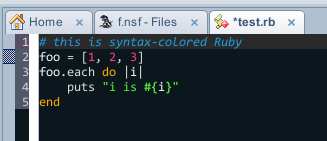
On my first attempts, I ran into problems where using DLTK's update site demands an updated version of Eclipse, which could mean disaster for Designer. However, it turns out that GLTK has been part of mainline Eclipse for a while, so I figured I'd check to see if I could get to it via another route. Evidently, Designer 8.5.3 is based on Eclipse 3.4 (Ganymede), so I added Ganymede's update site to Designer's plugin installation list and, lo and behold, Ruby was there in the "Programming Languages" section. It still required the 3.4 version of org.eclipse.core, but, having backed up my Windows VM for this purpose, I felt daring. I clicked "Select Required" to select all applicable dependencies and hit Yes as many times as it took to finish the installation. After rebooting Designer, I found that Ruby scripts are now all fancily colored:

Ruby in Designer

If you'd like to try this yourself, I strongly suggest you do as I did and make a backup copy of your Windows VM first (or do whatever it is people who use Windows as their host OS do when they're about to ruin their system). Designer can be very picky about what plugins you install.

Making the Dogfooding Switch

Sat Apr 07 23:55:00 EDT 2012

Tags: domino blog

I've finally done it: I've switched my blog over to Domino. I did it for a couple reasons:

  • To silence the voice in the back of my head constantly saying "why are you using WordPress? You're a freaking web programmer! Write your own!"
  • To put my Ruby-in-XPages code through its paces in the way only a live site can.

I've already had to fix a couple holes in my Ruby adapter, mostly revolving around the fact that I haven't bothered to properly handle serialization and JSF's StateHolder interfact. For now, I've patched the worst problems, but this gives me a great reason to come up with a proper solution. To test it out, I'm making sure to avoid "#{javascript: ...}" code blocks in favor of using plain-EL and "#{ruby: ... }" exclusively. So far, the only really awkward parts are the giant swaths of yellow-squiggly "I don't understand this" underlining in Designer and having to put xp:repeat values on xp:dataContexts rather than writing the computation inline. Not too shabby.

The whole thing's a bit shoot-from-the-hip at the moment, since it's only existed for a day. There's no search (though that'll be easy), the site design is from my old college-era blog, and I have to write the posts' HTML by hand in the Notes client (you know, like on all modern blogging platforms). But hey, I have the old posts in there, plus an archives list and, as long as it doesn't mysteriously die again like it did a minute ago, Akismet-backed commenting.

So let's see how this thing works! Don't be surprised to see the WordPress version again if things go catastrophically wrong.

Import from SQL to NSF: It's So Easy!

Fri Apr 06 19:57:00 EDT 2012

Tags: domino sql

I decided I should probably finally get around to moving this blog from WordPress to Domino, if for no other reason than to have a perfect testbed for the weird stuff I've been doing lately. The first task is to write an importer, so I decided to just do a straight SQL rows -> Domino documents import. This couldn't be easier if you follow this simple guide:

  1. Write a Java agent that uses the appropriate JDBC connector for your database. In my case, it's MySQL, so I had it do a "show tables" to get a list of tables, then loop over those to do "select * from whatever" statements to get all documents.
  2. Since it's Domino, you can just do doc.replaceItemValue(column, rs.getObject(column))!
  3. Oh wait, you can't all the time. Make sure to handle a couple cases, like converting BigIntegers to longs and Timestamps to DateTimes.
  4. Wait, Domino doesn't even handle Boolean? For frack's sake, FINE: row.replaceItemValue(column, cell.equals(Boolean.TRUE) ? 1 : 0);
  5. Oh hey, that import went really smoothly! Now I'll just make some views based on the table name and... crap. Forgot to include the table name! Maybe I shouldn't have written this importer at four in the morning.
  6. Better delete all the documents and start over.
  7. What's this, an error when I went to delete all the documents in the All view? "Field is too large (32k) or..." oh no.
  8. Oh crap.
  9. Crap!
  10. Ah, I know - I'll just write an agent to do session.CurrentDatabase.AllDocuments.RemoveAll(True) and that'll fix that.
  11. Hmm, nope, that didn't work. Alright, based on the documents created around the same time, I can guess that it's the "option_value" field that's too big. Why did it even cram that data into summary if it completely breaks the document? Well, no point in dealing with that now. It's time for StampAll to take care of that!
  12. Nope? Okay, how about session.CurrentDatabase.GetView("All").AllEntries.StampAll?
  13. Not all categorized? What kind of error message is THAT?
  14. Time to delete the database and start over!
  15. Alright, THIS TIME, check to see if the String value is over, let's say, 16000 bytes and, if so, store it in a RichTextItem instead.
  16. Oh nice, it worked.
  17. Oh crap, I forgot to include the table name again.

And that's all there is to it!